Coming Soon

This case study is being updated.

← Back to Work
← All work
HR Tech · 2023–2024

From Data to Decisions: Designing a DE&I Intelligence Tool for Hiring Teams

Lead Product Designer Scale-up, HR Tech Squad of 6

I reframed a dashboard brief into a commercially validated decision support tool that shipped to 20 enterprise clients in its first month and got featured in Forbes.

20
Enterprise clients in month one, including Sainsbury's
40%
Of customers indicated willingness to pay
60%
Of clients made meaningful adjustments to hiring strategy
800
Candidate surveys synthesised with AI to surface behaviour patterns

A Decision Engine, Not a Dashboard.

Hackajob had the data. The question was whether we could turn it into something that actually changed what hiring teams did on Monday morning.

The brief was simple: build a dashboard. The real problem was harder.

Hackajob collected rich data across the hiring funnel but had no way to surface it meaningfully. Nobody had defined what decisions that dashboard should actually enable.

"

'Reframing the problem from a dashboard to a decision engine was the pivot.'

The question that changed everything we built

Before a pixel was pushed I stopped the squad and asked a different question. Not "what data do we have?" but "what decisions are our customers actually struggling to make?" That single reframe changed the product, the positioning, and the commercial outcome.
Assumption mapping. Cross-functional workshops. Customer interviews.

I ran assumption mapping sessions with PM and engineering. Facilitated cross-functional workshops. Interviewed customers and the CS team.

The answer was clear: companies were flying blind on why candidates were declining interviews, how their funnel compared to peers, and whether their brand was actually attracting the talent they wanted.

A dual-track discovery model I introduced to the organisation.

  • Lean UX, moderated & unmoderated usability testing, fake door tests
  • 800 candidate surveys synthesised with Dolphin AI — a new workflow in 2023
  • Sessions with 5 industry thought leaders and HR consultants
  • Future state scenario mapping including a 2026 "Scouts" hypothesis
  • Weekly CS collaboration sessions & customer interview cadence
Hypothesis & Results · Phase 1

Hypothesis: By surfacing reasons for decline with actual candidate voice, we would help companies understand why good candidates were walking away.

#F6E798 · Fake Door
44%
Sign-up intent
Phase 1 — Talent Insights

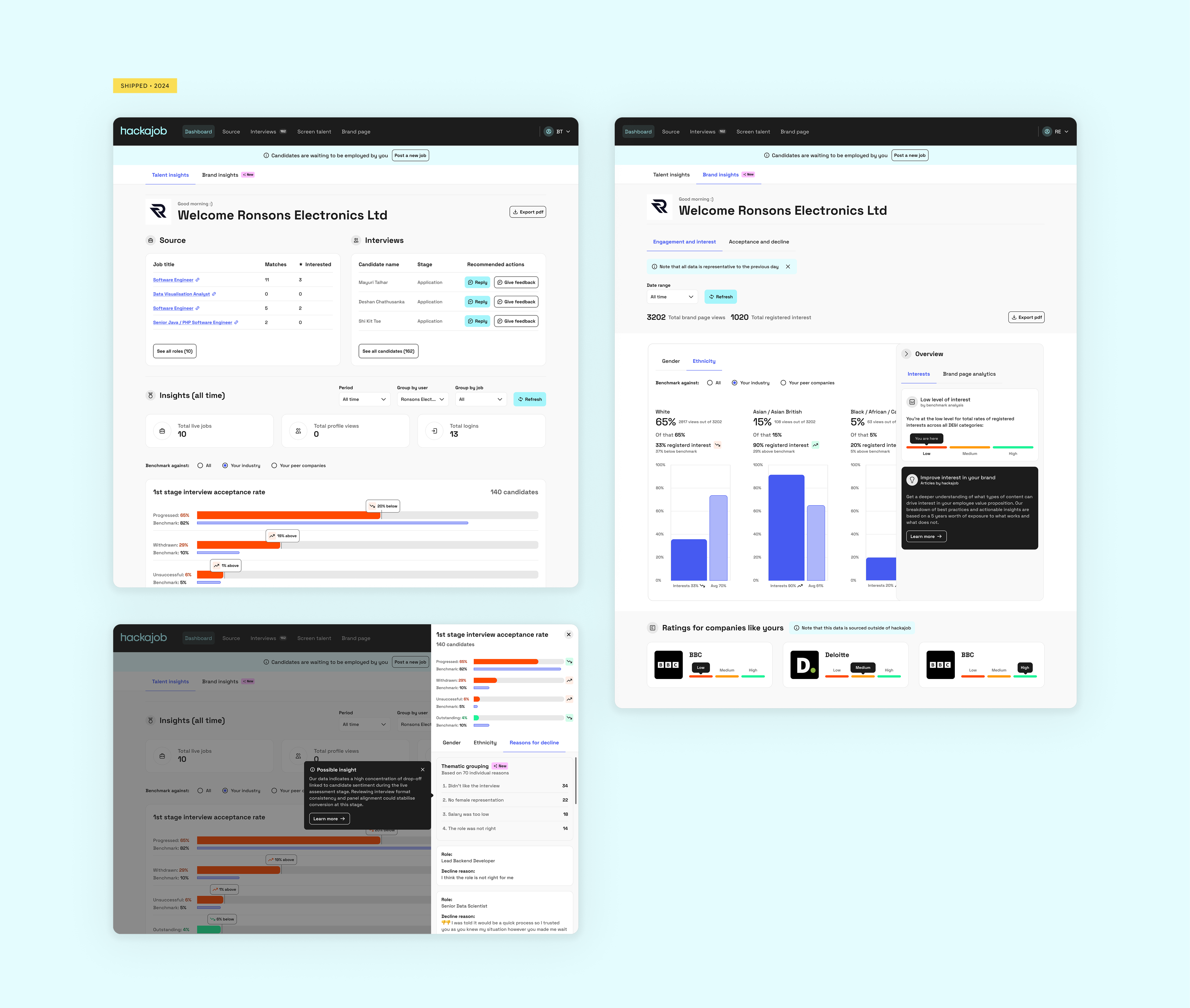
Shipped pipeline health views, DE&I breakdowns, and candidate voice.

The reasons for decline feature came directly from customer research. Companies told us they had no way to understand why good candidates were walking away. We designed the capture flow, built it into the candidate experience, and surfaced the verbatim feedback alongside AI-grouped thematic analysis inside the dashboard.

This was not a data-point-only dashboard. Every metric had a decision behind it.

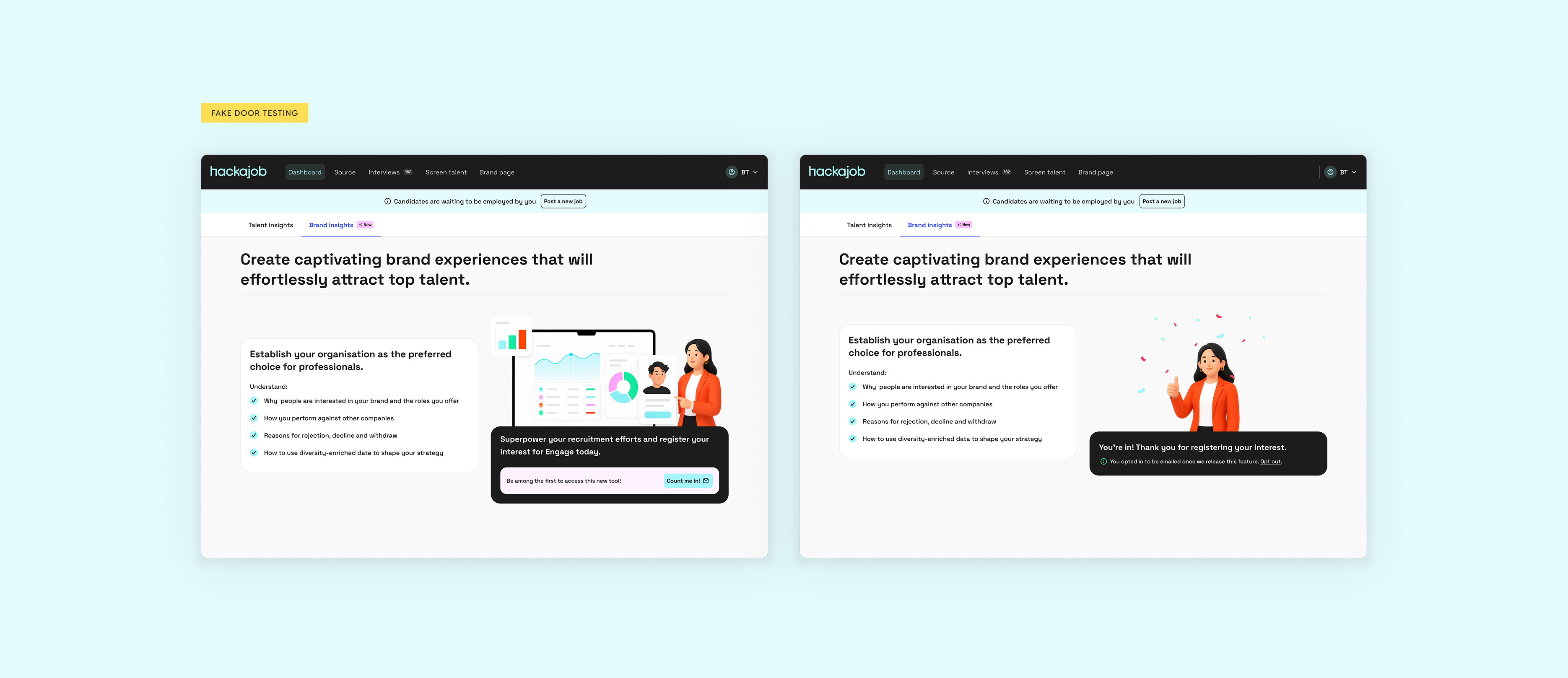
Fake door testing on the brand insights tab showed 44% sign-up intent against a 30% benchmark. Enough signal to accelerate into phase two.

User testing screenshot

Validation Phase

Moderated testing, unmoderated testing, and 800 candidate surveys.

Multi-method validation established rigor that went beyond a single usability pass. The approach influenced how Hackajob validated subsequent features across the product.

Phase 2 — Brand Insights

Richer intelligence: benchmarking, diversity lens, generative summaries.

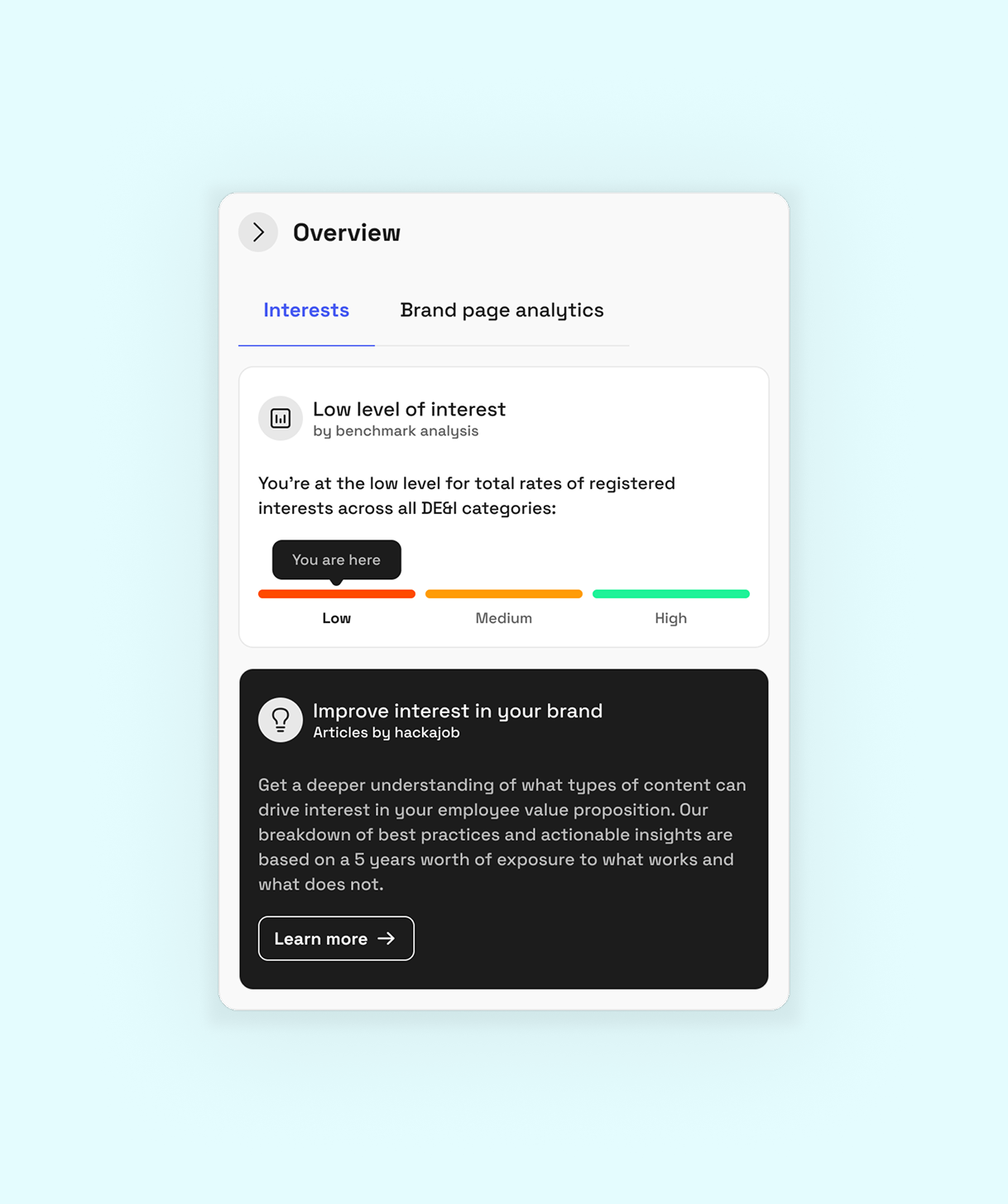
Built on the validation from phase one to ship a richer layer of brand and DE&I intelligence including gender and ethnicity breakdowns across engagement, acceptance and decline; industry and peer company benchmarking across all metrics; registered interest tracking on brand pages; and generative insight summaries surfacing plain English verdicts from complex data.

Hypothesis & Results · Grouping Insights

Hypothesis: By grouping decline reasons, we would see a 15% increase in user understanding of why candidates were walking away.

#F6E798 · Grouping
18.2%
Increase

AI Integration & Backend

Client
API
Data Synthesizer
(AI)
Compliance
Engine

AI Integration & Backend

Connecting the user experience to the compliance logic layer.

Designing for abstraction — so hiring teams got plain English insight without ever seeing the regulatory complexity underneath. The synthesiser grouped and surfaced patterns; the engine ensured everything stayed compliant.

Engage: A System of Decision-Making

Launch Final Deliverable

Featured in Forbes. 20 enterprise clients. Month one.

'The AI synthesis saved weeks of manual work.'

CS Team Lead · Hackajob  ·  anonymous / wireframe

The team moved toward TA leader dashboards. My instinct said this wouldn't be sticky.

I ran the workshops democratically and supported the direction — but my instinct was that a recruiter activity dashboard with no active recruiting has no value. When the market contracted, I was proven right. I should have advocated harder when the data was pointing elsewhere. That is the learning.

Less passive reporting. More active decision enablement.

A product that tells you: you are losing qualified engineers to Capgemini because you take 11 days to respond and they take 3. Here is what you can change this week.

That thinking influenced what I explored at Deel and what Hackajob has since moved toward with their agentic hiring experience.

Next case study

Shipping at Scale: Deel Engage →
← All work